The lens that many working photographers consider an essential part of their kit, regardless of the system they use, is the 24-70mm constant aperture zoom (full frame equivalent). It is an especially useful range for events such as weddings or conferences where you are dealing with moving subjects, tight spaces and varied compositions, from wide-angle shots of the location to close-ups of attendees and specific details. Though these zooms don’t deliver the same sharpness or brightness as high-quality prime lenses, they are useful for fast-paced events where changing lenses isn’t practical.
As of today, there are two mid-range constant aperture zooms for Micro Four Thirds. The Panasonic Lumix 12-35mm has been around since mid-2012, while the M.Zuiko 12-40mm made its appearance in late 2013 when the OM-D E-M1 was launched. Both feature a constant aperture of 2.8, meaning that they can be used even in difficult light conditions.
This past month was the first time I actually had the two zooms side-by-side for an extended period of time, so I couldn’t pass up the opportunity to write up an official comparison!
Ethics statement: Within the article, there are affiliate links. If you buy something after clicking the link, we will receive a small commission. Don’t worry – prices remain the same for you. To know more about our ethics, you can visit our full disclosure page. Thank you!
Build and Design
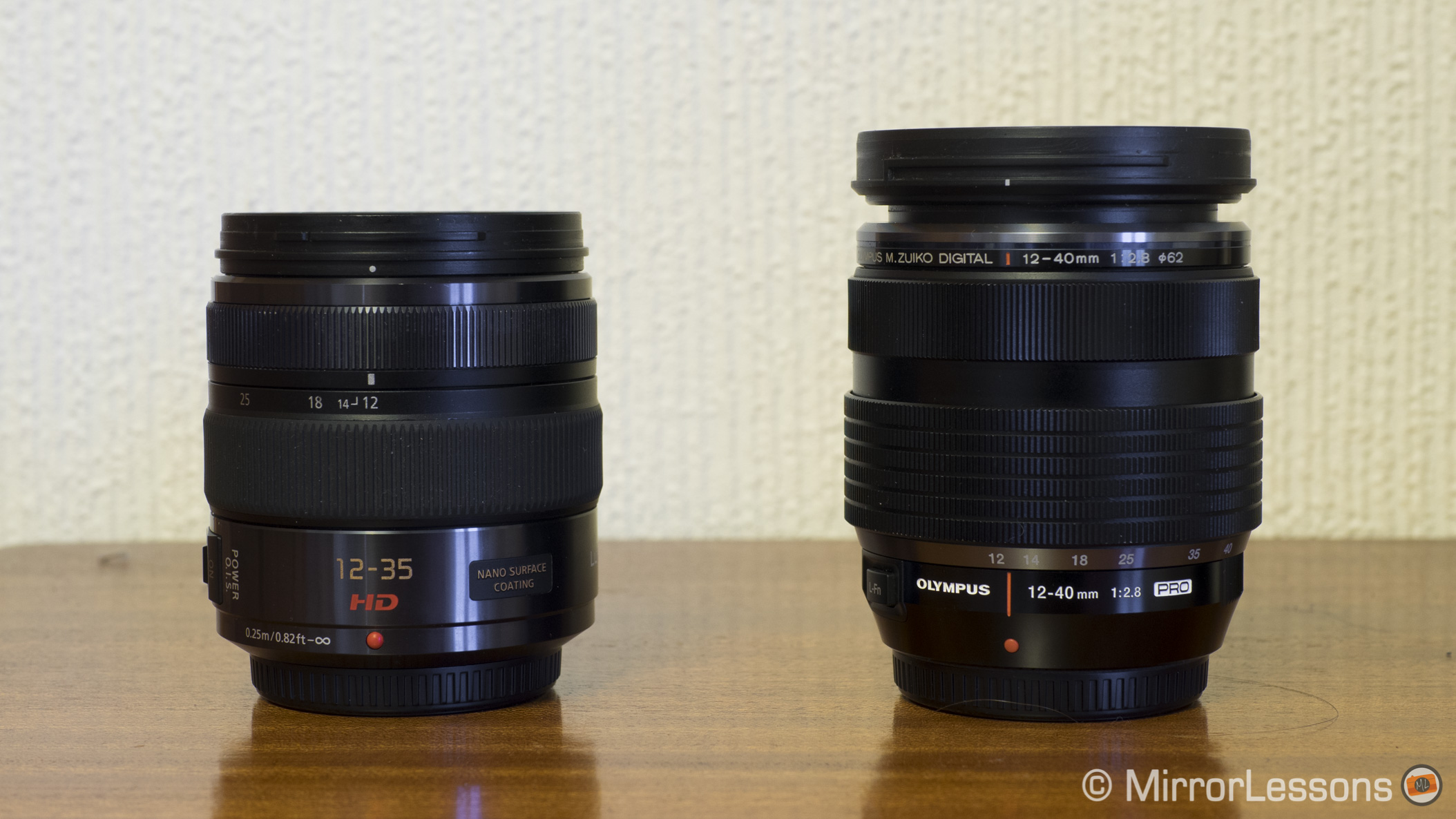
When used individually, both lenses come across as very compact and light considering that they are constant aperture mid-range zooms. Comparing them side-by-side, however, you’ll soon notice that the 12-40mm is slightly taller (8.4cm vs. 8cm at 12mm and 13cm vs. 10cm with the front element fully extended), heavier (382g vs 305g) and wider than its counterpart.
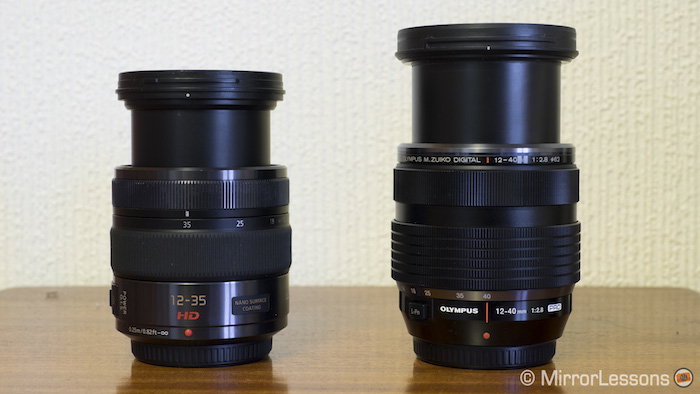
Both lenses are metal and weather-sealed. It is worth bearing in mind that the weather-sealing makes more sense when combined with a weather-proof body such as the Olympus OM-D E-M1 or Panasonic Lumix GH4. Olympus claims that the 12-40mm is dust, splash and freeze proof, while the Lumix is only dust and splash proof.
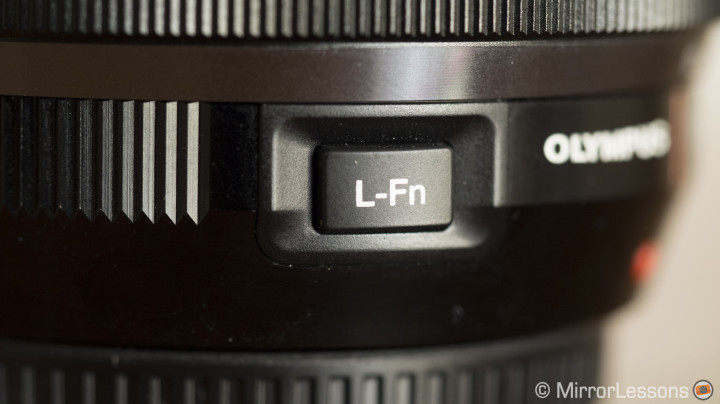
The body of the M.Zuiko is more complete than that of the Lumix. In addition to the metal ribbed zoom ring, there is a metallic manual focus clutch mechanism that allows you to switch to manual focus when slid back. Doing so also reveals a distance scale that you can use to make precise adjustments to focus. Another nice touch is the customisable L-Fn button on the barrel. By default, it suspends continuous autofocus when something comes between you and your subject.
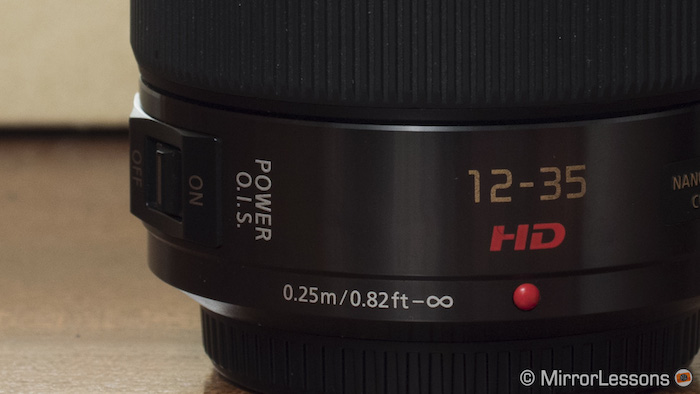
The Lumix too has a ribbed manual focus and zoom ring but the latter is covered in rubber. Though it attracts more dust, I actually prefer rubber rings as they are more comfortable to use on cold days. It doesn’t have a clutch mechanism nor a function button but it does benefit from a Power O.I.S. (optical image stabilisation) switch, a feature I’ll discuss in more detail later on.
The most important focal lengths are marked beside the zoom ring on both lenses and both come with a petal-shaped lens hood that is easy to attach and does a good job of shielding the lens from the sun. The only difference between the hoods is that the Olympus version has two release buttons on either side that you must squeeze to twist it off.
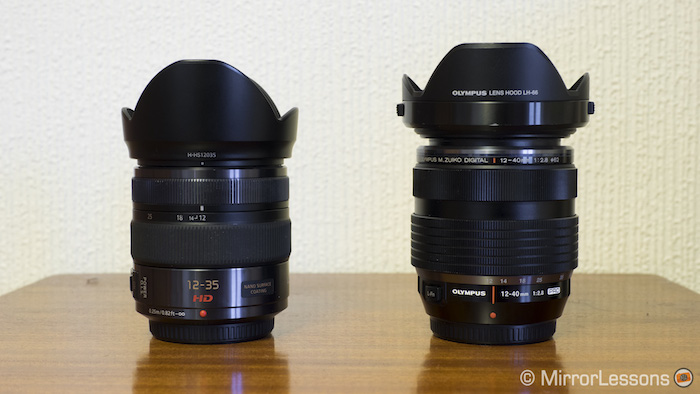
In terms of design and build, there isn’t much that can be said against either lens. If I had to say which feels sturdier, I’d give the prize to the Olympus, but there is much to be said for the diminutive size and weight of the Lumix.
Image Quality – Through the lens


Focal Range
The M.Zuiko 12-40mm is a 24-80mm equivalent, meaning that you have more reach on the telephoto end compared to the Lumix 12-35mm. In a real world situation, I haven’t found that having those extra 5mm makes a huge difference but it does make the 12-40mm a more suitable portrait alternative.

I did notice that the two zooms produced slightly different compositions when set to the same focal length, especially when focused close or zoomed out to the longer focal lengths. However, this is of little significance in the real world because a) you are unlikely to own both zooms and continually want to compare them, and b) photographers usually frame their images according to the elements they want to include in the frame.
Sharpness
To test the sharpness of the two zooms, I used them both on the Micro Four Thirds model with the highest megapixel count, the Panasonic Lumix GX8. (The various real-world images, on the other hand, were shot with both the Olympus OM-D E-M1 and Lumix GX8.)
Those worried about there being a dramatic difference in sharpness between the two zooms can rest easy – both perform very well throughout the zoom and aperture ranges. Neither is quite as sharp as a prime lens but the results are more than enough for most purposes.


Unsurprisingly, you can find the best performance from both lenses between f/4 and f/5.6 across the focal range. That said, anything up to f/11 is perfectly useable. It does seem that the M.Zuiko is more capable of extracting very fine detail across the frame at these apertures but the difference really is minimal.
The apertures where you’ll find the biggest difference are f/2.8 and f/4. At the centre and edges at 12mm, the M.Zuiko zoom reigns supreme, producing results that are noticeably sharper than those from the Lumix. This difference is less noticeable once you zoom in to 35mm but still there.




As I mentioned above, the M.Zuiko also extends to 40mm (80mm on full-frame). At this focal length, it is a little softer at the edges and corners, especially at the fastest aperture, but the performance is just as good at the centre. Its performance peaks at around f/5.6.


When the Olympus was first released, there were very high expectations surrounding its performance. People assumed it would easily blow the 12-35mm out of the water in terms of sharpness and rendering of detail. However, the truth is that while the 12-40mm is the better performer overall, its edge over the 12-35mm isn’t as large as we would expect.
If you are interested in seeing a full series of high resolution comparison shots taken at the various key apertures and focal lengths, please visit our dedicated SmugMug gallery!
Bokeh
The bokeh produced by both lenses at f/2.8 is very similar at both their respective longest and shortest focus distances. The only real difference is in the specular highlights, whose rendering appears somewhat cleaner from the M.Zuiko lens.

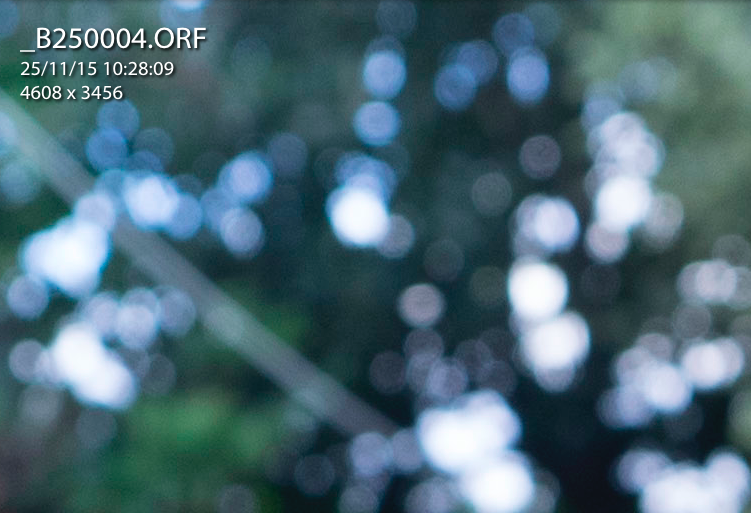
Of course, given the better macro performance and extra 5mm on the telephoto end of the 12-40mm, you can also achieve a slightly softer background and more subject isolation than with the 12-35mm at 35mm. Whether the bokeh is attractive is a more subjective matter; I personally find the rendering quite pleasant, especially when you focus close at the telephoto end.




Chromatic Aberration
Looking at our test shots, it is obvious that the Lumix lens suffers more from chromatic aberration, especially at f/2.8 and f/4. The Olympus lens, on the other hand, is very well-controlled even at its fastest apertures. All things considered, this isn’t a big issue as chromatic aberration can be removed in post-production quite easily.


Flare
Although both lenses suffer from various types of flare, much of it is negated by the petal-shaped lens hoods that come with the two zooms. What does appear when there is a direct light source in your image is a mix of purple and rainbow flare. Often, eliminating unwanted flare is is simply a matter of slightly adjusting your composition.





Vignetting
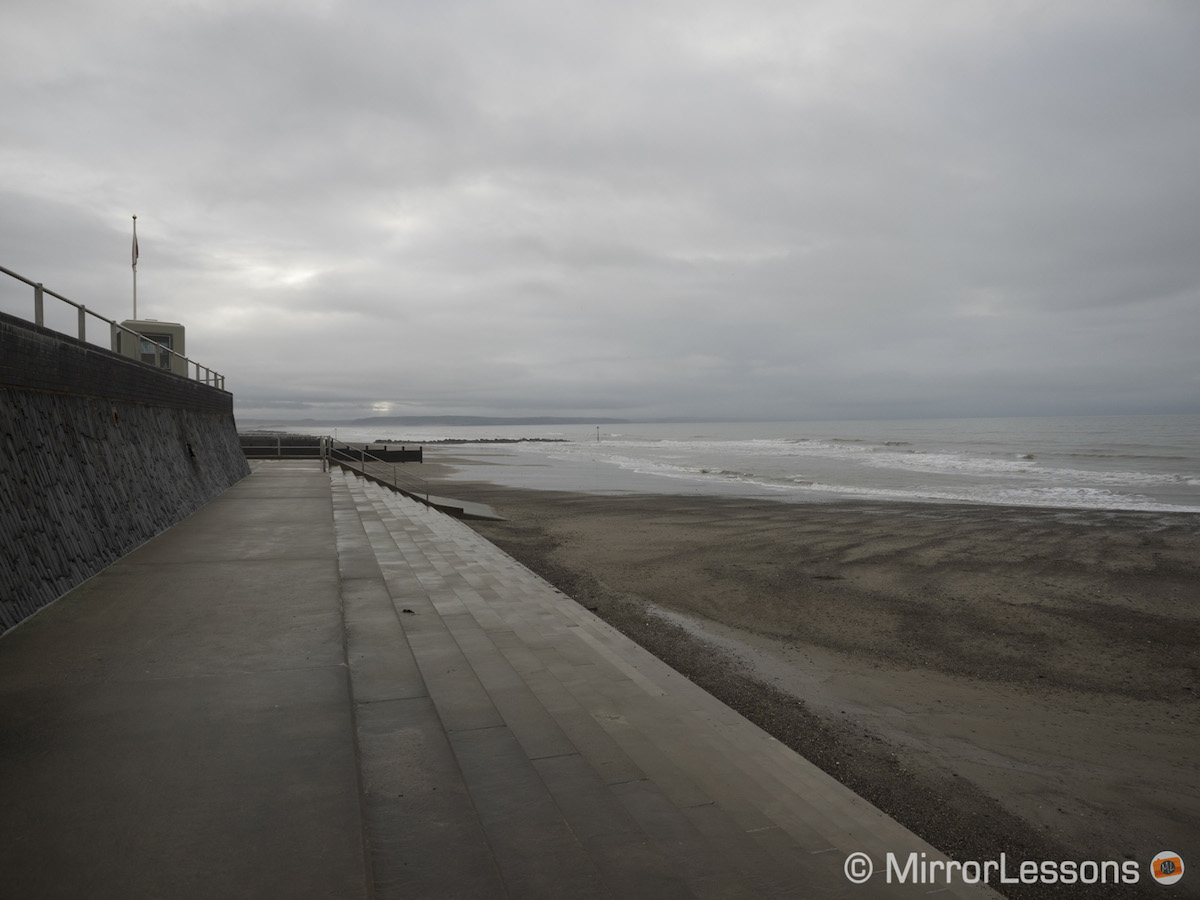
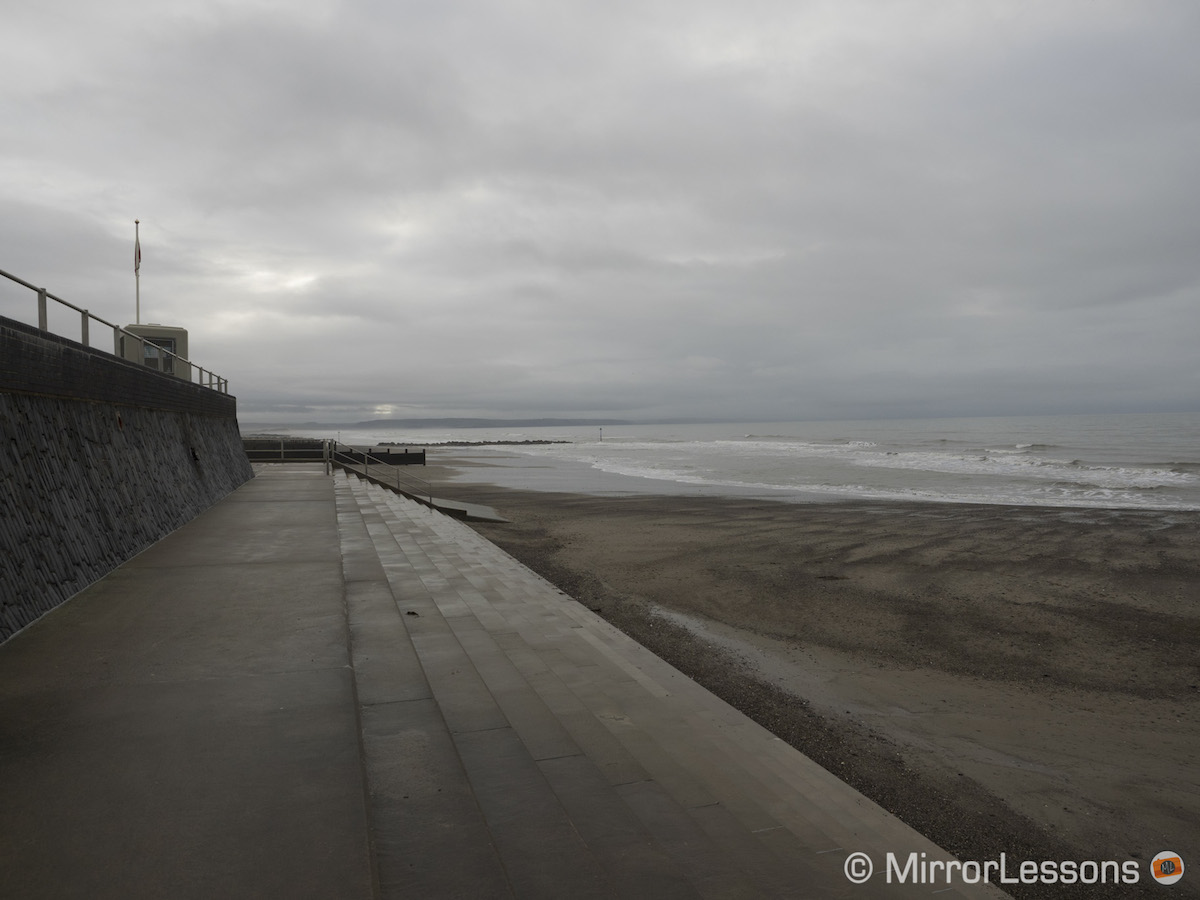
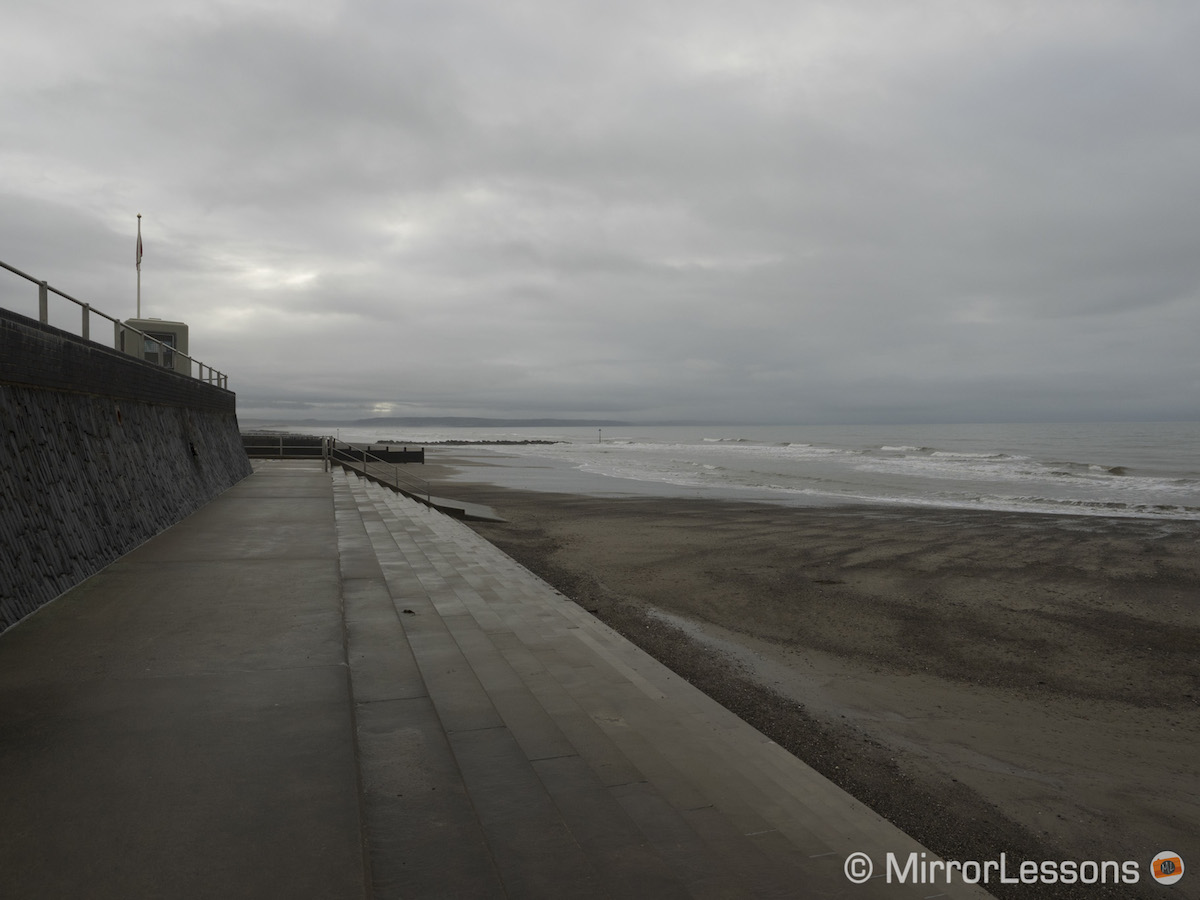
Vignetting, or light fall-off as it is otherwise known, isn’t a big issue on either the 12-35mm or the 12-40mm. Both lenses have mild but visible vignetting at f/2.8 which completely disappears by f/5.6.
Lumix 12-35mm


M.Zuiko 12-40mm
Distortion
As with any wide angle lens, you’ll come across some distortion at the widest end. In the case of both the M.Zuiko 12-40mm and Lumix 12-35mm, there is some mild barrel distortion at 12mm. Were distortion not automatically corrected in-camera, it would appear much worse.


Once you zoom in to their respective longest focal lengths, distortion is no longer relevant in field conditions.

Focusing
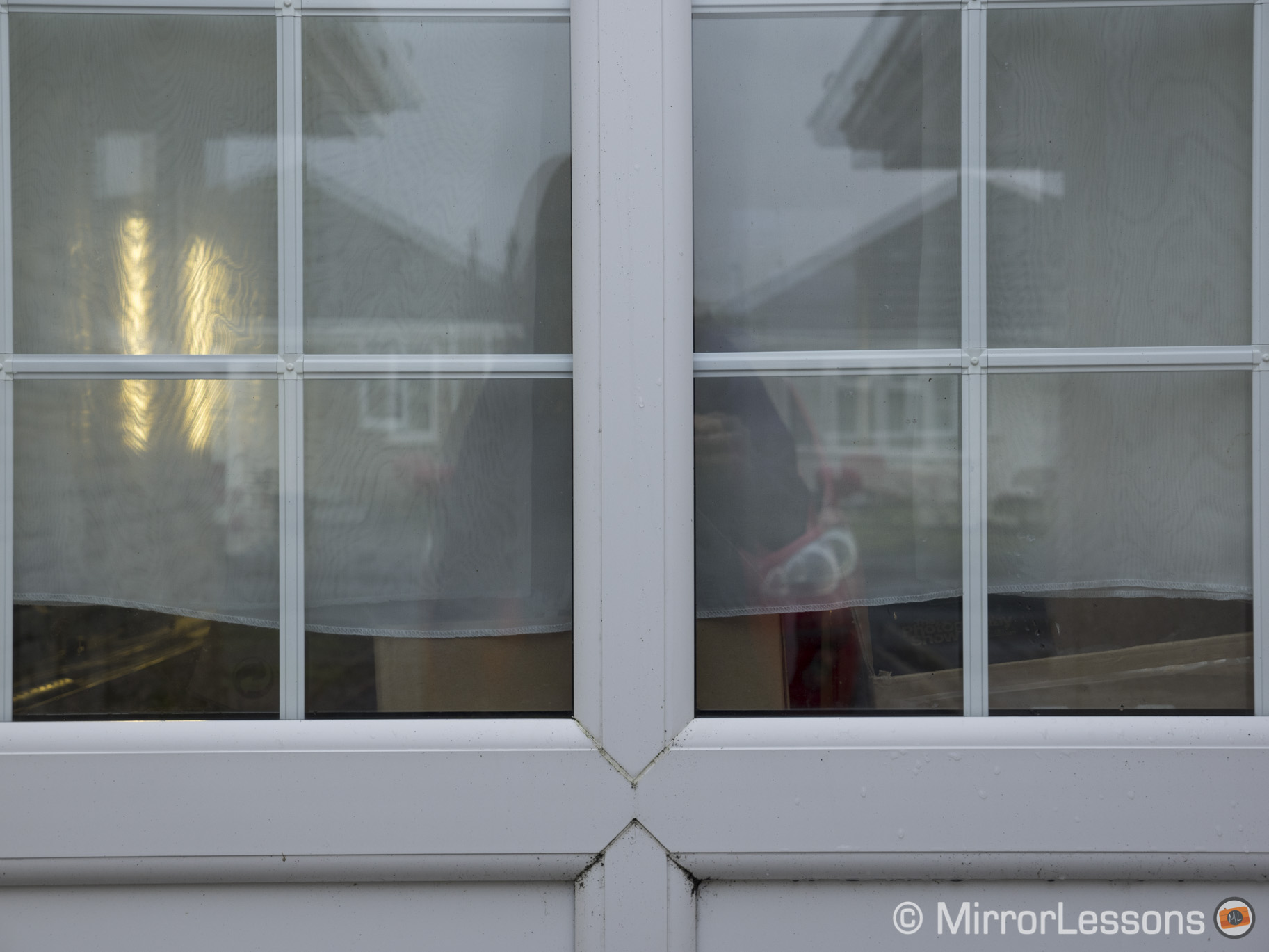
AF speed and accuracy is definitely one of the fortes of the Micro Four Thirds system. The M.Zuiko employs a MSC (Movie & Still Compatible) AF mechanism while the Lumix has a silent AF motor drive. Though the names are different, the result is the same – a quick, accurate and virally silent AF motor that is appropriate for stills and movie shooting. Both are excellent in good light and only slow down a little in poor light conditions.
The fly-by-wire manual focussing is a pleasure on both lenses thanks to their smooth ribbed focus rings. However the Olympus has a slight leg up over the Lumix in that it has a distance scale and a manual focus clutch mechanism. This means that you don’t have to go into the menu or fish around for a dedicated button or switch to change over to manual focus; you simply pull the ring back to enable it.
Regarding the close focusing capabilities, the Olympus once again has an advantage over the Lumix thanks to its minimum focus distance of 20cm and a maximum magnification of 0.3x. In fact, I’ve often used the 12-40mm as a stand-in for my M.Zuiko 60mm macro for semi-macro shots. The Lumix, by comparison, can focus as close as 25cm with a maximum magnification of 0.17x. This kind of performance is what you’d generally expect from a standard mid-range zoom.


Optical Stabilisation
There could only be one winner in this section: the Lumix 12-35mm. While the M.Zuiko 12-40mm lacks optical stabilisation altogether, the Lumix incorporates Power O.I.S. like many other lenses in the Lumix line-up, giving you stabilisation even with non-stabilised bodies.
The reason the Lumix is stabilised and the Olympus isn’t is due to how the two brands have opted to incorporate stabilisation into their respective camera systems. Most modern Olympus bodies tend to have 5-axis in-body stabilisation, so there is no need for optical stabilisation in the lenses. Conversely, most Lumix bodies don’t have in-body stabilisation, so Power O.I.S. is the only way to bring stabilisation to these bodies.
As I explained in my full review of the Lumix 12-35mm, the optical stabilisation is very good, delivering sharp results down to an average of 1.3s at 12mm and 1/10s at 35mm. When updated with the newest firmware and paired with the GX8’s Dual I.S. system, you can achieve even better results – specifically, an average of 1s at 12mm and 1/3s at 35mm.

Price
Originally, the Lumix 12-35mm was priced at $1299, while the M.Zuiko 12-40mm started out at $999. Now that they have both been around for some time, you can find them for much less than their original price. I’ve seen both for less than $600, so it is simply a matter of keeping your eye out for a good deal.
Conclusion


As you might have suspected, there is very little to say against either of these standard zooms. We’ve owned the M.Zuiko 12-40mm since its release and have never been disappointed by its performance. Of all the Micro Four Thirds lenses we own, it is probably the one that gets the most use due to the versatility of its focal range, close-focussing capabilities and excellent build quality. The Lumix 12-35mm, on the other hand, has the advantage of being smaller and lighter. What’s more, it incorporates excellent optical stabilisation, which is essential if you are using a non-stabilised body. It suffers more than the 12-40mm from chromatic aberration but today’s software programs are perfectly capable of removing the worst of it.
Personally speaking, I am happy that we chose the M.Zuiko 12-40mm f/2.8 even though it is larger and heavier than the Lumix. The close-focusing capabilities and slightly larger focal range come in handy all the time when I am shooting product shots or when I go out to take pictures for the website, and it is nice to have that extra sharpness at the fastest aperture. Plus, the fact that we only own stabilised bodies means that we don’t have to worry about using slow shutter speeds with this lens. That said, if I didn’t own a stabilised body – and that means most cameras in the Lumix range – the 12-35mm would be a no-brainer.

Choose the Lumix 12-35mm f/2.8 if:
– you prefer a very light and compact zoom
– you require optical stabilisation because you own a non-stabilised Lumix body
Choose the M.Zuiko 12-40mm f/2.8 if:
– you do a lot of manual focusing (the distance scale and clutch are very helpful)
– you want the sharpest rendering possible across the aperture and zoom range
– you plan to do lots of semi-macro work with the zoom
– you feel you could benefit from the extra 5mm in focal length
