• Skip to main content
  • Skip to primary sidebar
  • Archive
    • Camera Reviews
    • Lens Reviews
    • Accessory Reviews
    • In-Depth
    • Galleries
    • Guest Post
  • About Us
  • Our Websites
  • Contact Us
  • Privacy Policy
  • Youtube

MirrorLessons

Mirrorless camera reviews right at your virtual doorstep!

Heather

Mirrorless vs. DSLR in 2015: For which genres is the debate still relevant?

24/06/2015 By Heather

Much like the film vs. digital debate of yore, the question of mirrorless vs. DSLR is a topic that proliferates the web, from lengthy forum discussions to articles about the so-called “switch” from one system to another.

However, the truth is that, as much as we seem to want it to exist, there actually is no debate, at least for 90% of the most popular photography genres. We are no longer dealing with an abyssal difference in image quality. There is no longer a chasmic gap in speed and performance.

[Read more…] about Mirrorless vs. DSLR in 2015: For which genres is the debate still relevant?

Filed Under: In Depth, Mirrorless Musings

A Day at the Erddig Historic House – A “Mini” Panasonic G7 Review

22/06/2015 By Heather

This past Saturday, Mathieu and I were invited to a photo event held by Panasonic UK in association with the National Trust and Erddig, one of Wales’ most famed historic houses with a 1200-acre country park and extensive walled garden.

At the event, visitors were invited to try Panasonic’s wide array of Lumix cameras, from their point-and-shoot range to the high-end GH4. One of the newest cameras on display with the Lumix G7, the latest product in the G line-up and a significant upgrade from its predecessor, the G6.

[Read more…] about A Day at the Erddig Historic House – A “Mini” Panasonic G7 Review

Filed Under: Camera Reviews, G7, Panasonic Reviews, Reviews

Digiscoping with the Panasonic GH4 & Swarovski Optik scope – An Interview with Tara Tanaka

19/06/2015 By Heather

Welcome to our series of 100 interviews we will be holding with photographers who use mirrorless cameras for their work! “Switching to a smaller and lighter system” has become somewhat of a buzz phrase as of late, but many working photographers take this philosophy seriously. From medical reasons such as resolving back and shoulder pain to the simple realisation that bigger does not mean better, photographers are turning to mirrorless systems now more than ever before.

This week’s interview is with Tara Tanaka, an award-winning digiscoper who uses the Panasonic Lumix GH4 and a Swarovski Optik scope for her bird and wildlife photography. She was recently interviewed by Rob Knight on the popular podcast This Week in Photo about her work, and is one of the jury members for the Movement and Action category for this year’s Digiscoper of the Year photography competition.

[Read more…] about Digiscoping with the Panasonic GH4 & Swarovski Optik scope – An Interview with Tara Tanaka

Filed Under: Interviews

Interview with Product Managers Y. Hori and R. Noguchi of Sony Europe – A7rII, RX100 IV and RX10 II

18/06/2015 By Heather

During the press event at Pinewood Studios near London, we had the chance to sit down with two managers from Sony Europe, Yoma Hori (Product Manager for Interchangeable Lens Camera Digital Imaging) and Ryoko Noguchi (Product Manager for Digital Still Camera/Lens Style Camera Digital Imaging). We talked about the recently released A7r II, RX100 IV and RX10 II as well as the other mirrorless cameras from Sony.

[Read more…] about Interview with Product Managers Y. Hori and R. Noguchi of Sony Europe – A7rII, RX100 IV and RX10 II

Filed Under: Mirrorless News

Mirrorless News: Ricoh GR II and Canon G3X Announced

18/06/2015 By Heather

This week’s final pair of announcements come from Ricoh and Canon, the former with the long-awaited successor to the popular GR premium compact, and the latter with a competitor of the Sony RX10 series and Panasonic FZ1000.

Ricoh GR II

The second generation Ricoh GR II builds upon the success of the original GR, a premium compact camera released in 2013 that has continued to be a popular choice amongst street photographers due to its portable size, large sensor, relatively fast aperture and appealing focal length. It is also well-loved for its monochrome capabilities.

ricoh gr II
The Ricoh GR II

At first glance, it doesn’t appear as if much has changed. The camera retains almost the same body as its predecessor, the same GR Engine V processor, the same 16.2MP APS-C sensor and ISO range (100 to 25600) and the same 18.3mm (28mm equivalent) f/2.8 fixed lens with a two-stop ND filter.

Dive under the surface, however, and you’ll find that Ricoh has updated the camera in numerous ways – some subtle, others more significant.

ricoh gr II
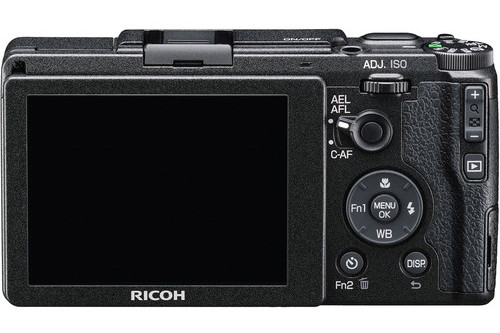
The rear of the Ricoh GR II

The biggest addition is WiFi and NFC connectivity. While it may not seem like anything exciting given that most modern cameras have this capability, the GR II is unique in that it can theoretically connect to any device that can run a browser and has WiFi. This includes not only standard Android and iOS devices but also the lesser known operating systems and even your computer’s desktop browser. Once connected, you have full remote control over every feature of the GR II with a live view feed. It will be compatible with the Pentax K-S2’s GR remote and Image Sync applications shortly after the launch, and will have support for a wireless flash control system.

Though the sensor remains the same, Ricoh claims that there is now better high-sensitivity noise compensation with improved resolution and contrast. Other additions that affect image quality include a new in-camera Raw processing mode called “Original ambient brightness” which produces a film-like rendering, pixel mapping, six new creative effects, and an enhanced and more accurate auto WB.

ricoh gr II
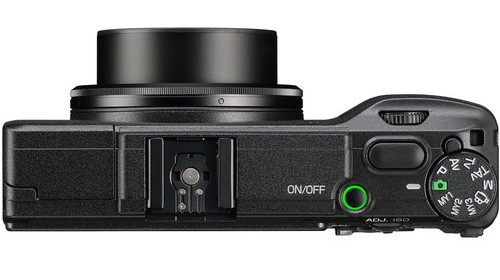
The top of the Ricoh GR II

The GR’s movie capture mode has also received a few necessary updates. You can now adjust your autofocus, exposure and creative effects while you record.

The camera still shoots at 4 fps in Raw/JPG like the previous model but the difference is that you can now shoot 10 Raw frames after the initial 4 fps burst before it slows down. The battery life has also improved, from 290 shots on the GR to 320 shots on the GR II.

You could easily call the Ricoh GR II a case of “If it ain’t broke, don’t fix it.” The original GR was and still is a hit, and the mark II simply fills in the technological gaps that today’s consumers require. It will become available in July at $800, which is about the same price as the original.

Canon Powershot G3X

A popular trend in digital cameras today are premium “superzoom” with a 1-inch sensor. The Sony RX10, with its 24-200mm zoom, kicked off the trend a year ago, and has since been followed by the Panasonic FZ1000 (25-400mm), the second generation RX10 II with the same zoom as the original, and now the Canon Powershot G3X, whose zoom range beats them all at an optical zoom range of 24-600mm (25X).

canon g3x
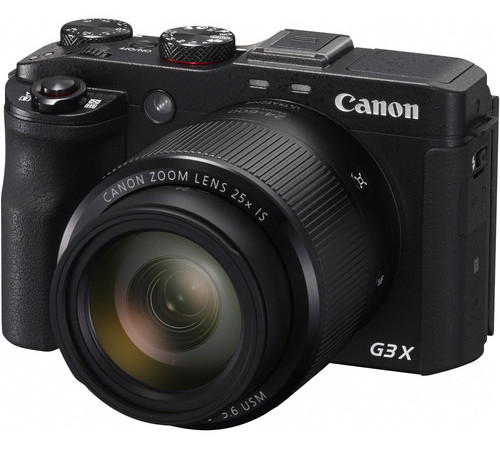
The 24-600mm super zoom of the G3X

However, a zoom this long ultimately calls for a more limited aperture range. While the RX10 twins have a constant aperture of f/2.8 and the FZ1000 ranges between f/2.8-4, the G3X is the least appealing at f/2.8-5.6. In short, those who require a brighter lens will certainly be more tempted by the offerings from Sony and Panasonic, whereas those who want the farthest reach possible won’t have to think twice about the G3X.

canon g3x
The rear of the G3X

Two other points that might sway the user towards the competition are the lack of an electronic viewfinder and inferior video performance. An EVF would have been an intelligent addition, as shooting with your eye to the viewfinder gives you more stability at the longer focal lengths. As for video, it is hard to justify only including 1080p HD video recording at 60p when the competition offers ultra high resolution 4K video.

canon g3x
The Canon G3X

Finally, Canon states that the G3X employs 5-axis stabilisation, though it isn’t the same technology found in the likes of the Olympus OM-D series and Sony A7 II / A7r II as it uses two optical axes and three digital axes.

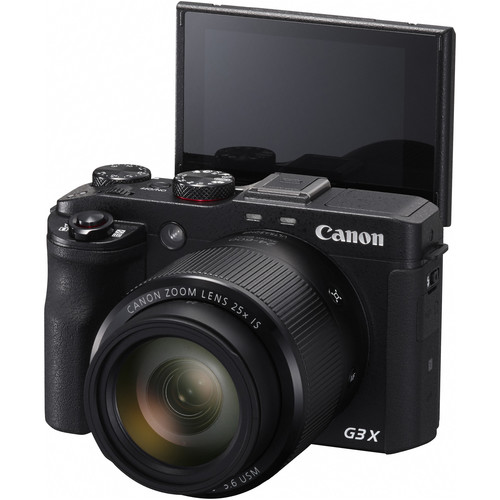
The G3X has a 20.2MP sensor (the same as the one found in the compact G7X), an ISO range of 150-12800, a water resistant body with a substantial grip and various external controls, a tilting touchscreen that can flip up 180 degrees for selfies, 5.9 fps continuous shooting, a DIGIC 6 image processor, a built-in ND filter, a headphone and mic jack, and WiFi and NFC capabilities.

canon g3x
Rotating touch screen for selfies

While it lacks some of the more modern features you might expect from a 1-inch superzoom, the Canon G3X remains an interesting addition to the line-up thanks to its extremely long telephoto reach. It will be available in July 2015 for around $999, making it quite a bit cheaper than the RX10 II (see our hands-on review here) but more expensive than the FZ1000.

Filed Under: Mirrorless News

  • « Go to Previous Page
  • Page 1
  • Interim pages omitted …
  • Page 26
  • Page 27
  • Page 28
  • Page 29
  • Page 30
  • Interim pages omitted …
  • Page 87
  • Go to Next Page »

Primary Sidebar

Reminder

We have moved! Our latest reviews can be found on Mirrorless Comparison and YouTube.

DISCLAIMER & COPYRIGHT NOTICE

Heather Broster is participant in the Amazon Services LLC Associates Program, an affiliate advertising program designed to provide a means for us to earn fees by linking to Amazon.com and affiliated sites.

Heather Broster is a participant in the Amazon EU Associates Programme, an affiliate advertising programme designed to provide a means for sites to earn advertising fees by advertising and linking to Amazon.co.uk.

Heather Broster and Mathieu Gasquet are also participants in the following affiliate programs: B&H Photo Affiliate Program, Ebay Partner Network, Skylum (Impact Radius), Expert Shield, The Inspired Eye, and Mediterranean Photo Tours.

To read more information, visit our full Disclaimer page. Thank you!


© HEATHER BROSTER/MATHIEU GASQUET AND MIRRORLESSONS, 2013-2024

Unauthorized use and/or duplication of this material without express and written permission from this blog’s author and/or owner is strictly prohibited. Excerpts and links may be used, provided that full and clear credit is given to Heather Broster/Mathieu Gasquet and Mirrorless Comparison with appropriate and specific direction to the original content.