• Skip to main content
  • Skip to primary sidebar
  • Archive
    • Camera Reviews
    • Lens Reviews
    • Accessory Reviews
    • In-Depth
    • Galleries
    • Guest Post
  • About Us
  • Our Websites
  • Contact Us
  • Privacy Policy
  • Youtube

MirrorLessons

Mirrorless camera reviews right at your virtual doorstep!

In Depth

A first look at Panasonic’s Post Focus function with the Lumix GX8

25/11/2015 By Mathieu

Today Panasonic released an interesting firmware update for Lumix GX8, G7 and FZ300 (bridge camera) users. The new and highly anticipated Post Focus feature allows you to select the focus point after taking the shot. From the first SLR camera with autofocus capabilities introduced in the eighties to this new feature, there’s no doubt that photographic technology has come a long way in a relatively short period of time.

[Read more…] about A first look at Panasonic’s Post Focus function with the Lumix GX8

Filed Under: GX8, In Depth, Micro four thirds tips and tricks, Mirrorless camera tips and tricks

These Kings. These Subterraneans – Photography, words and music by Patrick La Roque

30/10/2015 By Mathieu

Last month, X-Photographer Patrick La Roque asked if we would like to review his latest artistic project “These Kings. These Subterraneans” as we had also reviewed his first e-book 1 Eye, Roaming back in 2013. Photography e-books are not one of the main topics we cover here at MirrorLessons but we never discard the chance to share something a little different. Plus, we have been following Patrick’s work with the Fujifilm X series since we created this website, so we were curious to see what his new project was about.

[Read more…] about These Kings. These Subterraneans – Photography, words and music by Patrick La Roque

Filed Under: In Depth, Mirrorless Musings

5 Good Reasons to Choose a Mirrorless Camera with a Flip Screen

08/10/2015 By Heather

A month or so ago, I was hiking through Nant Gwernol forest with the Panasonic LX100, taking pictures of the trees, shrubs and running water from every imaginable angle. At one point, I decided to lie down on the damp rock bed to capture the following shot:

While I’m not convinced that the shot was worth the mud on my jeans and jacket, what I do know for certain is that if the LX100 had a flip screen, I probably would have saved myself a load of laundry!

Flip screens are a great invention, and quite a common feature on today’s mirrorless cameras and premium compacts. They make it possible to take shots that would otherwise be very challenging to compose.

Of course, this isn’t to say that everyone advocates flip screens. Before the announcement of the Fujifilm X100T, for example, fans of the series were divided into two groups: those wanting a tilting LCD and those adamantly against one. Some believed that a flip screen would ruin the design or unnecessarily increase the dimensions of the X100 series cameras, while others were open to change.

It is true that a flip screen can increase the bulk and weight of a camera and can also be more fragile than a regular screen, but in our personal experience, we’ve found that the positives outweigh the negatives. Below you’ll discover just why we’d go for a mirrorless camera with a flip screen over one without.


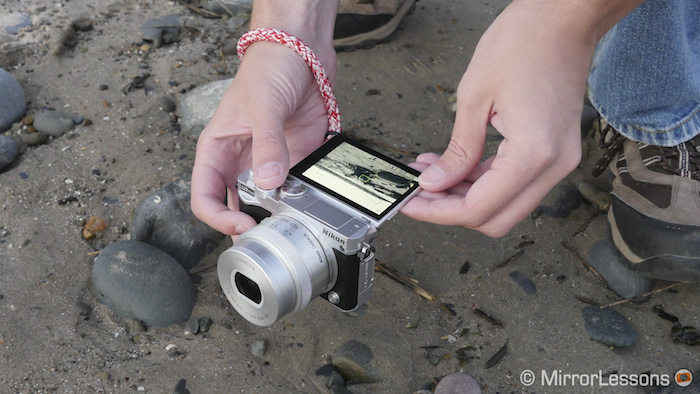
Easier to take shots at very low or high angles

DMC-GX8, 1/15, f/ 4/1, ISO 800
Shooting at a very low angle with the Nikon 1 J5

The first point relates back to my experience in Nant Gwernol. The shot I had visualised had to be taken from a very low angle to fit in the canopy of ancient trees and their web of branches against the sky.

Had I used a camera with a flip screen, I could have simply knelt down, held the camera down near the ground, and tilted the screen up to get a good view of the scene. Since I didn’t have a tilting screen, my only options were to kneel down and blindly guess at my composition, or lie on the ground and compose.

You could similarly imagine being at a concert, surrounded by people much taller than you. (Something that happens to me all too often!) A person without a flip screen would have to raise their camera in the air, snap a random picture and cross their fingers for a decent composition. In a scenario like this, nothing beats tilting the screen down to see exactly what you’re shooting.

Of course, a second option could be to set your camera up on a tripod, tether it to your smartphone and use your mobile device as a second screen but the process of setting up the camera and connecting the two devices wirelessly can’t be done instantaneously and it isn’t always practical.


Good for selfies

ILCE-6000, 1/640, f/ 45/10, ISO 1600
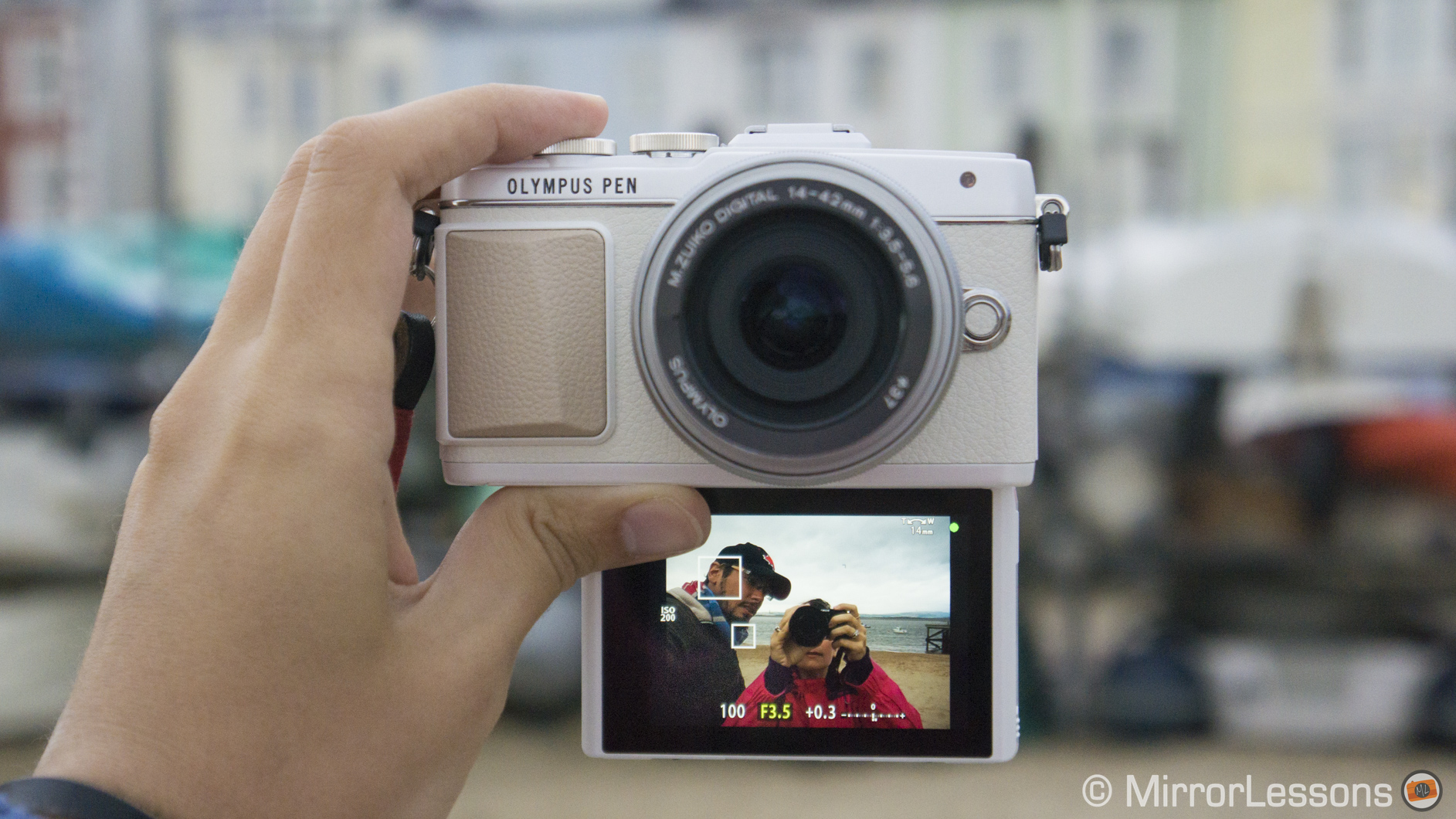
Taking a selfie with the Olympus Pen E-PL7

Now here’s a point that’s bound to stir up some controversy! Love them or hate them, selfies have become part of mainstream photography, so to have a camera that makes them easier to take can only be a good thing.

There are a number of mirrorless cameras out there that have screen which, when flipped up 180 degrees, automatically activates a selfie mode. This mode will usually trigger a 2-second timer so you can prepare yourself for the shot, as well as a face or eye detection mode to keep your features in focus. Our favourite “selfie” cameras include the Olympus Pen E-PL7, Panasonic Lumix GF7 and Samsung NX Mini.


Discretion on the streets

DMC-GX8, 1/30, f/ 4/1, ISO 400
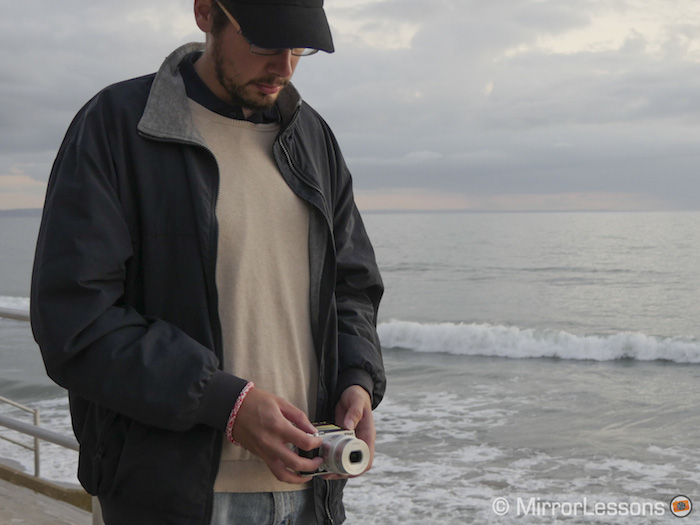
Trying to remain discreet by holding the camera at waist level

When out shooting candid street photography, there is no questioning the benefits of a flip screen. So as not to attract the attention of people on the streets, I tend to flip the screen up 90 degrees, hold the camera at waist level, look down at the screen, and pretend to be reviewing my images whereas in actual fact, I am snapping pictures.

This method is anything but new. Street photographers have been holding their cameras at waist level and looking down into the finder ever since twin-reflex cameras like the Rolleiflex came onto the scene. It is probably in this way that prolific photographers such as Vivian Maier managed to get so close to their subjects without drawing too much attention to themselves.


Avoid reflections on LCD

Having a flip screen isn’t just about overcoming awkward angles but also about avoiding reflections on the screen. When the sun’s rays hit your LCD screen at a certain angle, the reflections are often so intense that you can’t even see the image on your screen. An alternative could be to use a viewfinder, but if your camera doesn’t have one, a flip screen is your next best bet. You can adjust its position until the reflections disappear, or at the very least, cease to interfere with your view of the screen.


More flexibility for video

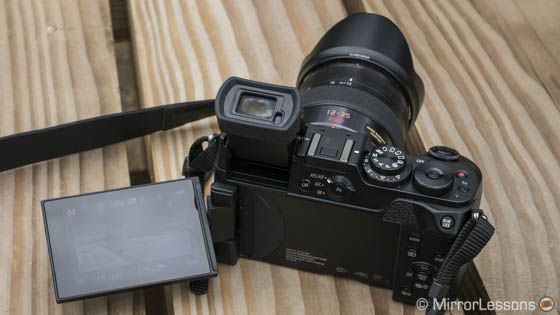
mirrorless camera flip screen

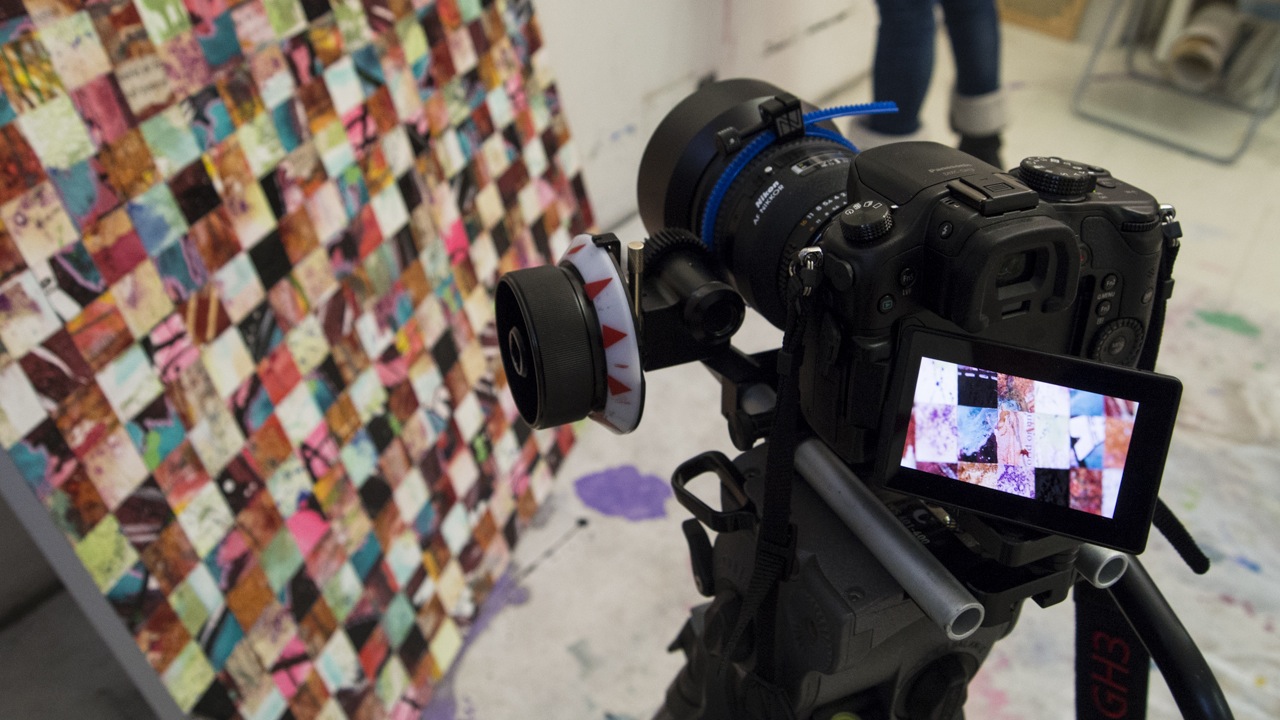
Prosumers/entry level camcorders and certain mirrorless cameras designed partly for video use (the Lumix GH4 or OM-D E-M5 II for example) have an articulating LCD screen that flips to the left and can often rotate up by 180°. As Mathieu learned during his professional filmmaking years in Italy, having a screen like this is more useful for videomakers than a monitor that only tilts up or down or doesn’t move at all.

There are various reasons this helps the user experience. A rotating display can help the filmmaker check his footage from multiple angles especially when the camera is positioned in a confined space and the rear is not easy to access. Flipping the display to the side can be useful when you need to check accessories or buttons while filming or preparing the composition. If you are shooting with an assistant, flipping the LCD around and rotating it by 180° can help him check the focus and various other settings. During an interview, such as the one we held with artist Deborah Rushton using the Lumix GH3, you can quickly rotate it to show the other person the composition, or when prepping the camera, you can orientate the screen in such a way that you don’t have to check the back of the camera every two seconds.


Conclusion

Flip screens have become a ubiquitous feature on most modern cameras. My personal feeling is that it is better to have one than not, even if they do add some slight extra bulk your camera. After all, if you don’t want to use it, all you have to do is leave it in position and pretend it isn’t there. But if you do encounter a situation where the muddy ground is the only thing standing between you and a great shot, you’ll know exactly what to do … and it doesn’t involve dirtying your best attire!

Filed Under: In Depth, Mirrorless Musings

The Sony A7r II Review, Chapter I: The autofocus test

29/09/2015 By Mathieu

Cover photo shot with the A7r II and Sigma 150-600mm f/5-6.3 C

More than a month has gone by since I started using the A7r II intensively. My review is still a “work in progress” because there is a lot to say about this camera. Given the interest in and enthusiasm for Sony’s new flagship model, I decided to take my time to gather as much information as possible. I also decided to split my findings into several articles rather than publishing only one so as to avoid making the article too long.

[Read more…] about The Sony A7r II Review, Chapter I: The autofocus test

Filed Under: A7r mark II, In Depth, Mirrorless camera tips and tricks, Sony mirrorless camera tips and tricks

What 10 Faithful X-Pro1 Users Would Like to See on the Fuji X-Pro2

24/09/2015 By Heather

The Fujifilm X-Pro 1 was the first interchangeable lens camera in the extremely popular line-up of Fujifilm X series cameras, and has become something of an iconic symbol alongside its non-interchangeable brother, the X100.

Now, nearly four years on from its release, X-Pro1 users and Fujifilm fans are on tenterhooks awaiting the arrival of its rumoured successor, the X-Pro2. Of course, with so much build-up and high expectations surrounding the arrival of this camera (if and when it arrives), Fujifilm is under a great deal of pressure to satisfy the needs and desires of its user base. Will they be able to make everyone happy? Probably not, as is always the case, but there are certainly a handful of common features that most photographers will want to see on the second iteration.

[Read more…] about What 10 Faithful X-Pro1 Users Would Like to See on the Fuji X-Pro2

Filed Under: In Depth, Mirrorless Musings

  • « Go to Previous Page
  • Page 1
  • Page 2
  • Page 3
  • Page 4
  • Page 5
  • Page 6
  • Interim pages omitted …
  • Page 16
  • Go to Next Page »

Primary Sidebar

Reminder

We have moved! Our latest reviews can be found on Mirrorless Comparison and YouTube.

DISCLAIMER & COPYRIGHT NOTICE

Heather Broster is participant in the Amazon Services LLC Associates Program, an affiliate advertising program designed to provide a means for us to earn fees by linking to Amazon.com and affiliated sites.

Heather Broster is a participant in the Amazon EU Associates Programme, an affiliate advertising programme designed to provide a means for sites to earn advertising fees by advertising and linking to Amazon.co.uk.

Heather Broster and Mathieu Gasquet are also participants in the following affiliate programs: B&H Photo Affiliate Program, Ebay Partner Network, Skylum (Impact Radius), Expert Shield, The Inspired Eye, and Mediterranean Photo Tours.

To read more information, visit our full Disclaimer page. Thank you!


© HEATHER BROSTER/MATHIEU GASQUET AND MIRRORLESSONS, 2013-2024

Unauthorized use and/or duplication of this material without express and written permission from this blog’s author and/or owner is strictly prohibited. Excerpts and links may be used, provided that full and clear credit is given to Heather Broster/Mathieu Gasquet and Mirrorless Comparison with appropriate and specific direction to the original content.